Enter your shipment's dimensions and weight to quickly determine your freight class and estimate your LTL shipping costs.
Freight Class Chart
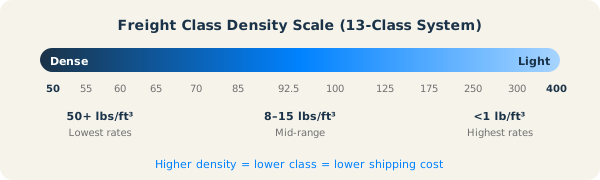
As of July 2025, the NMFTA uses a 13-tier density-based classification scale (replacing the previous 18-class system). Classes range from Class 50 (the densest, lowest rate) to Class 400 (the lightest, highest rate). A lower class number means a lower per-shipment cost.
Freight Class
Density (lbs/ft³)
Common Examples
50
50+
Bricks, cement, mortar, hardwood flooring
55
35 to 50
Concrete blocks, Portland cement, steel rods
60
30 to 35
Car accessories, machine parts, steel cables
65
22.5 to 30
Bottled beverages, boxed books, car parts
70
15 to 22.5
Canned foods, auto engines, unassembled furniture
85
12 to 15
Crated machinery, cast iron stoves, tires
92.5
10 to 12
Computers, monitors, refrigerators
100
8 to 10
Boat covers, car covers, wine cases, cabinets
125
6 to 8
Small household appliances, vending machines
175
4 to 6
Clothing, couches, stuffed furniture, mattresses
250
2 to 4
Bamboo furniture, plasma TVs, aluminum tables
300
1 to 2
Wood tables, chairs, kayaks, deer antlers
400
0 to 1
Ping pong balls, large ornamental items, sculptures
What's a Freight Class?
When you ship products via LTL (Less-Than-Truckload), your shipment gets assigned a freight class, a standardized code between 50 and 400 that carriers use to determine your shipping rate. Carriers use this code to price shipments based on what you're sending and how it handles in transit.
In July 2025, the NMFTA streamlined this into a 13-tier density-based scale (down from 18 classes). Class 50 covers the densest, easiest-to-handle freight and carries the lowest rates. Class 400 covers the lightest, bulkiest items and carries the highest. Knowing where your shipment falls helps you budget accurately and avoid reclassification fees.
The classification system was created by the National Motor Freight Traffic Association (NMFTA) and is used by virtually every LTL carrier in North America. Whether you're shipping a pallet (skid) of canned goods or a crate of electronics, your freight class directly impacts what you pay.
How to Calculate Your Freight Class
Freight class is primarily based on density: the relationship between your shipment's weight and the space it occupies. Here's how to calculate it in three steps:
Step 1: Measure your shipment dimensions (length, width, height) in inches.
Step 2: Calculate volume in cubic feet.
(Length × Width × Height) ÷ 1,728
Step 3: Calculate density.
Weight (lbs) ÷ Volume (ft³) = Density
Once you have your density in pounds per cubic foot, match it to a freight class using the reference chart above, or enter your dimensions and weight into the calculator to get your result instantly.
Measurement tips
Always measure the outer dimensions of your packaging, not the product inside. Carriers measure the footprint your shipment occupies on the truck, so it's the box that counts. For palletized freight, measure the full pallet including any overhang.
What Determines Your Freight Class?
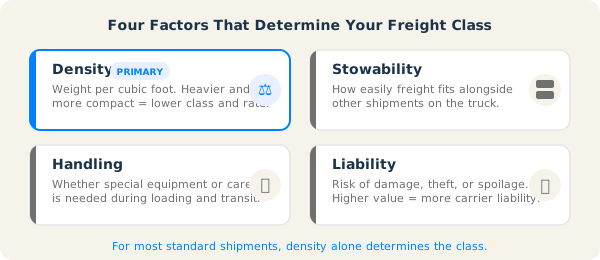
While density is the most common factor (and what our calculator uses), carriers may evaluate four characteristics when classifying your shipment.
Density
The weight per cubic foot of your shipment. This is the primary factor for most freight and the basis for density-based classification. Heavier, more compact shipments qualify for a lower class and a lower rate.
Stowability
How easily your freight can be arranged alongside other shipments on the truck. Standard pallets stow easily. Irregular shapes, oversized items, or hazardous goods are harder to stow and may result in a higher class.
Handling
Whether your shipment requires special equipment or attention during loading and transport. Freight that needs extra handling (fragile goods, temperature-sensitive products) may be classified higher.
Liability
The risk associated with shipping your goods, including their value, fragility, and susceptibility to damage or theft. Higher-value or more perishable items carry more liability for the carrier.
For most standard shipments, density alone determines the class. However, certain commodities like hazardous materials, fine art, or live plants may be assigned a fixed class regardless of their density.
Freight Classes for Corrugated Packaging
Corrugated packaging has specific NMFC (National Motor Freight Classification) codes that determine how carriers classify it for LTL shipping. If you're shipping pallets of boxes — whether flat-packed or assembled — knowing the right code helps you avoid reclassification fees and quote accurately.
Common NMFC codes for corrugated products
Three NMFC codes cover the majority of corrugated packaging shipments:
NMFC 29785 — most flat corrugated mailer boxes, the most common code for e-commerce packaging
NMFC 29800 — corrugated containers and shipping boxes (general category)
NMFC 29810 — corrugated partitions and dividers
How flute type affects weight and density
The flute profile of your corrugated board directly impacts the weight and density of your shipment, which in turn affects your freight class:
E-flute (1/16") — lightest, used in mailer boxes and retail packaging
B-flute (1/8") — good balance of cushioning and printability, common in mailer boxes
C-flute (5/32") — standard shipping box flute, more cushioning
BC double wall — heaviest, used for heavy or fragile goods
The specific NMFC sub-code depends on construction (single wall vs double wall), whether the box is shipped knocked flat or assembled, and the commodity packed inside. Always verify the specific NMFC code with your carrier or freight broker before shipping.
For most Packwire customers shipping custom mailer boxes or custom shipping boxes, NMFC 29785 or 29800 will apply.
Worked Example
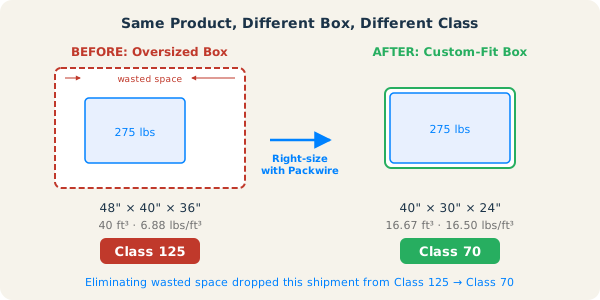
Let's say you're shipping a pallet (sometimes called a skid) of packaged goods. The shipment measures 40" × 48" × 36" and weighs 275 lbs. Here's how to find the freight class:
Volume:
40 × 48 × 36 = 69,120 in³ ÷ 1,728 = 40 ft³
Density:
275 lbs ÷ 40 ft³ = 6.88 lbs/ft³
Result: A density of 6.88 falls in the 6 to 8 range = Class 125
At Class 125, this shipment falls in the mid-range, common for items like small appliances and vending machines. If you could reduce the box size or add more weight to the pallet, you might push the density above 8 and qualify for Class 100, which would mean a lower shipping rate.
How right-sizing helps
Now imagine you swap that oversized 40" × 48" × 36" box for a custom box that fits snugly at 40" × 30" × 24", same 275 lbs:
New volume:
40 × 30 × 24 = 28,800 in³ ÷ 1,728 = 16.67 ft³
New density:
275 lbs ÷ 16.67 ft³ = 16.50 lbs/ft³
New class: 16.50 falls in the 15 to 22.5 range = Class 70
By right-sizing the packaging, this shipment drops from Class 125 to Class 70, a meaningful reduction in per-shipment cost from eliminating wasted cube. For recurring shipments, the savings compound quickly. Use our Box Size Optimizer to find the ideal dimensions for your products.
Tips for Reducing Your Shipping Costs
Your freight class directly impacts your bottom line. Here are a few practical ways to optimize your shipments and potentially qualify for a lower class.
Right-size your packaging
Use the smallest box or crate that safely fits your product. Eliminating void space increases density, which can move you into a lower freight class. This is one of the most straightforward optimizations, and it's what custom packaging is designed for. Packwire offers custom shipping boxes and custom mailer boxes built to exact dimensions, so every shipment is as dense as possible. Even trimming a couple of inches off each dimension can meaningfully change your density calculation and bump you into a lower class.
Palletize efficiently
Stack cartons to maximize pallet cube utilization. A tightly packed, shrink-wrapped pallet will yield a noticeably better density than loosely stacked boxes. When possible, arrange cartons so they interlock and fill the full pallet footprint — a standard 40" × 48" pallet with gaps around the edges wastes cube that you're paying for. If your boxes don't tile neatly onto the pallet, consider adjusting your box dimensions so they do.
Consolidate smaller shipments
Rather than sending multiple small packages individually, combine them onto a single pallet. More weight on the same footprint means better density, and LTL carriers charge per shipment, so fewer shipments also means fewer accessorial fees, fuel surcharges, and handling charges. If you ship to the same destination regularly, consolidating into weekly pallets instead of daily parcels can add up to significant savings.
Measure accurately
Carriers will re-weigh and re-measure at the terminal. If your actual dimensions don't match what you declared, expect reclassification fees and adjusted invoices. Use a tape measure on the outer dimensions of the packed box (not the product inside), and weigh on a calibrated scale. Rounding down or estimating may save a few minutes upfront but can cost you in surprise charges later.
Compare quotes from multiple carriers
Different LTL carriers price the same freight class differently depending on the lane, volume discounts, and their own network capacity. It pays to compare rates from at least two or three carriers, especially on recurring lanes where even a small per-shipment difference compounds over time. Many third-party logistics platforms let you compare quotes side by side in minutes.
Frequently Asked Questions
Freight class is one of the primary factors in your LTL rate. Declaring the wrong class can trigger reclassification and additional charges. Knowing your class upfront helps you quote accurately and avoid billing adjustments.
This calculator provides a density-based estimate, which is how most shipments are classified. However, certain commodity types have a fixed class that overrides the density calculation. We always recommend confirming your freight class with your carrier before shipping.
LTL (Less-Than-Truckload) is when your shipment shares truck space with other shippers' freight. Freight class applies to LTL shipments. FTL (Full Truckload) is when you book the entire truck. Freight class typically doesn't apply to FTL because you're paying for the whole trailer.
Some carriers still reference the legacy 18-class system. Our calculator defaults to the current 13-tier scale, but after calculating you can click "View result under legacy 18-class system" to check both.
You can't arbitrarily select a class, but you can influence it. By optimizing your packaging to increase density (right-sizing boxes, eliminating void space, and palletizing more efficiently) you can legitimately qualify for a lower, less costly class.
Most flat corrugated mailer boxes fall under NMFC 29785. General corrugated shipping containers use NMFC 29800, and corrugated partitions/dividers use NMFC 29810. The exact sub-code depends on box construction, whether it ships flat or assembled, and the product inside. Always confirm your NMFC code with your carrier before shipping.
Directly. Freight class is primarily determined by density (weight ÷ volume). A smaller box with the same weight has higher density, which means a lower freight class and lower shipping costs. This is why right-sizing your packaging matters — eliminating dead air inside the box raises your density and can drop you one or two freight classes. Try our Box Size Optimizer to find the smallest box for your products.
Yes. Off-the-shelf boxes almost always leave excess space, which lowers your density and pushes you into a higher (more expensive) freight class. Custom-sized boxes from Packwire eliminate that wasted space. Combined with our 3D configurator, you can design packaging that fits your exact product dimensions and potentially save on every LTL shipment.
How Packwire Helps You Lower Freight Costs
Every cubic inch of empty space inside your box is working against you. Oversized packaging inflates your volume, lowers your density, and pushes you into a higher freight class. That's where we come in.
Custom-sized to your product
We don't do one-size-fits-all. Every Packwire box is built to your exact dimensions, so there's no wasted space inflating your shipment volume. A tighter fit means higher density and a lower freight class.
Digital CAD and Laser Cutting
Digital CAD cutting and laser cutting replace traditional dies entirely, which means no tooling costs and no setup fees. Adjust your box dimensions between orders, test multiple sizes, and land on the exact fit before scaling up your production run.
Lower minimums, faster iteration
Need to test whether a smaller box drops you a freight class? Use our Box Size Optimizer to find the right dimensions, then order a short run, measure the results, and scale up once you see the savings. No 5,000-unit minimums, no guesswork.
Real savings on every shipment
Right-sizing your packaging can drop you one or two freight classes and lower your freight class rating overall. With custom shipping boxes sized to your product, the savings on recurring LTL lanes compound over time.
Ship Smarter with Custom Packaging
The right box size can lower your freight class and save you money on every shipment. Design custom packaging that fits your products perfectly!
 , fast delivery, and backed by our world-class customer service every step of the way.
  1-800-881-6093